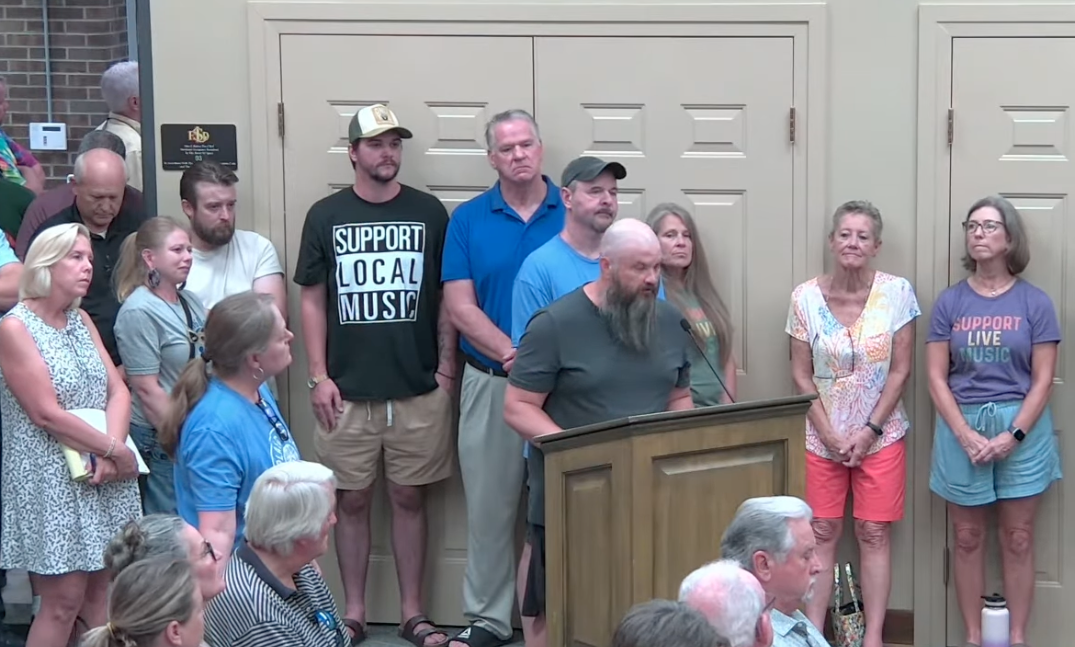
For three hours Monday night, Loveland residents and business owners offered starkly different accounts of the same downtown soundscape. To some, it was the thriving entertainment district the city spent years building. To others, it was a nuisance that has made their homes unlivable.
The city council heard both sides in force during open forum at the July 14 meeting, with nearly 20 speakers addressing what has become the most contentious local issue in recent memory. What emerged was not a simple conflict between business and residents, but a deeper question about what Loveland wants to be.
"We need to know what is permitted," said Ben Capodagli, owner of Cappy's Wine and Spirits in downtown Loveland. "We need to know what is not permitted, and we need that clarity sooner rather than later."
Capodagli described recent police responses to noise complaints about a solo acoustic guitarist playing at his business—a musician who had performed monthly without incident for years. On another occasion, police responded after the business had closed, responding to a complaint about loud music that had ended more than two hours earlier.
But residents living near downtown told a different story. Randy Campion, who lives on South Riverside Avenue, said the noise occurs three to four nights a week.
"All we hear across the river is the bass and the drums," Campion said. "All we hear is bam, bam, bam, bam, bam for three hours, three or four days."
David Bishop, who has lived on South Riverside for more than 40 years, offered a legal framework. He cited what he described as the legal standard for nuisance noise: "any unnecessary or excessive sound that injures or endangers the comfort, repose, health, peace and or safety of others."
"The simple solution is turn the volume down," Bishop said. "That's all it takes."
But the issue is more complex than volume alone. The city's own ordinances are scattered across multiple codes—zoning ordinance and general code—making them difficult to understand and enforce. City Manager Dave Kennedy acknowledged this problem.
"There is a provision specifically for noise in the zoning, and there's one specifically in our general code," Kennedy said. "It is very confusing. It needs to be clarified."
The city is working to address this through the Law and Ordinance Committee, which has already held two meetings on the issue. A third meeting is scheduled for July 22 at 6 p.m.
Council Member Brian Goodyear, vice chair of the committee, said the goal is not to eliminate outdoor music but to create a single, unified ordinance that is easier to understand and enforce.
"There's no desire on our part to either eliminate or severely limit the idea of playing live music outdoors," Goodyear said. "The only issue is trying to make sure that things are done in a reasonable, balanced way."
The committee is considering moving away from decibel-based standards—which are difficult to enforce—toward a "reasonableness" standard that would consider time of day, day of week, and circumstances.
But the debate revealed deeper tensions about Loveland's identity and future.
David Nielson, who moved to Loveland specifically for its downtown, warned against retreating from the city's own vision.
"This town made a choice to move forward for families like mine," Nielson said. "And I heard that promise. We came. Our children heard it. And they're staying. Loveland families will keep moving here if we keep moving forward. But if we start moving backwards, everything this council will work for that is bearing fruit will die on the vine."
Matt Powell, who owns several downtown businesses including the Lofts, the Landing, and Bishop's Quarter, put a dollar figure on the stakes. His businesses alone have an annual payroll of around $1 million and spend up to $100,000 yearly on local and regional musicians.
"If live music is cut short, restricted, or diminished in some manner by several hours every weekend, those dollars don't simply disappear from our business, they disappear from Loveland," Powell said.
Yet residents made clear they are not opposed to entertainment—only to the volume and frequency of noise that extends beyond business property lines.
Sharon Scovanner, who lives on Overlook Drive, offered practical solutions: turn down the volume, move musicians indoors, install sound barriers, or relocate musicians from elevated decks where sound travels farthest.
"The right to quiet enjoyment is a foundation of property rights in the United States," Scovanner said. "A landowner can put their property to any lawful use as long as they do not deprive adjoining owners the right of enjoyment of their property."
The 2019 Downtown Strategic Development Plan calls for creating a downtown "centered around experiences, hospitality, gathering spaces, and activity." It identifies entertainment as part of downtown's identity and encourages "activation of public spaces."
The Nisbet Park master plan includes more than $400,000 invested in a new permanent stage as part of an enhanced amphitheater and community gathering space.
"These aren't my ideas," Capodagli said. "These are the city's own plans. As a downtown business owner, I've responded to that vision."
Kennedy said the city is leaning toward a reasonableness-based code with decibel levels available as backup in certain circumstances. He emphasized that no final ordinance draft has been presented yet.
"What would be presented to law and ordinance at the next meeting is still very generic," Kennedy said. "I want to get some semblance of input from residents and business owners."
Council Member John Hart said both sides want the same thing: clarity and consistency.
"Very clearly, I think even on both sides, people do want it to just be clear, consistent," Hart said. "We want to make sure that it's easy to enforce."
Vice Mayor Andy Bateman urged the community to "turn down the volume on this as an existential crisis on what we're doing with downtown Loveland."
"This is a subjective issue and it is delicate," Bateman said. "But that's not really what we're trying to solve for. We're trying to understand that there are complaints that have been occurring and we want to recognize that there may be gaps in our legal precedent."
The Law and Ordinance Committee meets July 22 at 6 p.m. at City Hall. The meeting is open to the public.